

THE TROJAN HORSE IS A GIFT
The Fortress Blueprint | Managing the Capacity CRISIS
by Tiana Symmonds | June 12, 2026
I retired at 46. It wasn't luck. It was strategy.
The corporate environment you left behind does not want you to remain free. The moment you step into the role of a sovereign architect, a silent counter-offensive begins from your old ecosystem. This threat is rarely an operational failure or an overt market collapse. It is a highly profitable, deeply flattering offer that does not align with your architectural blueprint.
When you exit the tactical execution container to operate as a visionary leader, the market notices the sudden vacancy. The systems you used to maintain still require manual labor, and the leaders within those broken systems prefer your direct execution over building their own infrastructure. They do not want you to advise them. They want you to do the heavy lifting for them.
The primary challenge to your sovereign survival arrives disguised as validation. These requests come from legacy corporate environments, former enterprise clients, or trusted colleagues within your professional network. They offer immediate capital for tasks you no longer perform. A past client approaches you with an urgent operational issue, and they are willing to pay an immediate premium for your manual intervention.
This is the Trojan Horse. It looks like an asset. It looks like financial acceleration. In reality, it contains a liability structure designed to dismantle your infrastructure from the inside.
When you accept capital for work that falls outside your zone of genius, you commit a critical structural error. You step down from the drafting table and enter the demolition zone. You revert from a visionary leader to a tactical fixer. The market is testing whether your new identity is a permanent infrastructure choice or a temporary position. If your boundaries collapse for an easy check, your professional network learns that your executive presence has a price.
THE ANATOMY OF THE INVADER
The invaders do not approach your business with hostility. They arrive with compliments, references to your historical competence, and substantial budgets. To defend your operation, you must classify these requests by their structural behavior rather than their financial size.
THE INVASION DECONSTRUCTION MATRIX
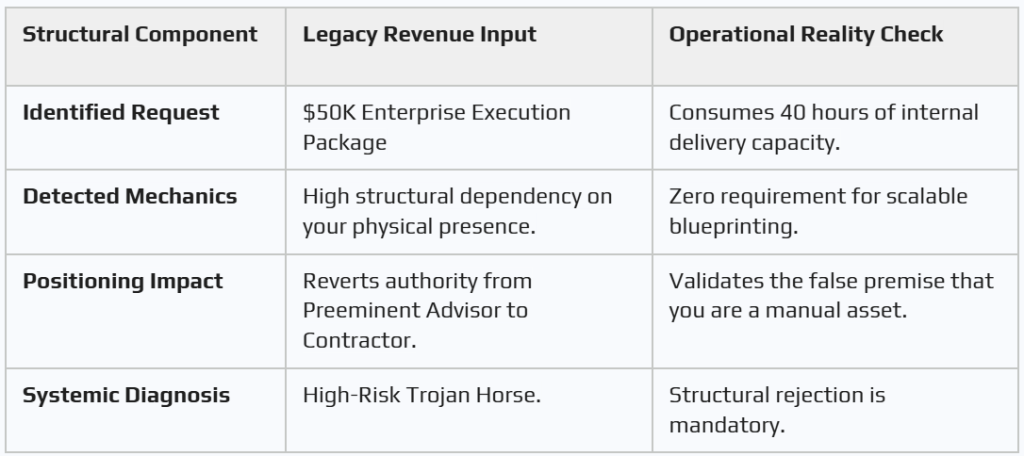
A corporate executive who transitions into fractional entrepreneurship is highly susceptible to this pattern. In my previous role at Amazon, HP, or KIPP, my value was tied to my speed in resolving immediate problems. When an organization suffered an operational failure, I deployed my energy to stop the bleed. I was praised for being a manual fixer.
So, I know personally… When you build your own advisory firm, that exact praise becomes a structural hazard. A business owner who remains available to fix every minor failure cannot build a scalable enterprise. You become the single point of failure in your own architecture. The legacy client who offers you a contract to manage their internal project is not supporting your growth. They are purchasing your capacity to avoid fixing their own broken governance systems.
THE CAPACITY CRISIS REVISITED
Accepting misaligned opportunities creates an immediate Capacity Crisis. This is the systemic failure of subsidizing broken organizational processes with your own biological peace. It is not an individual management failure. It is an architecture failure.
When you allow a legacy client to occupy your calendar with manual execution, you drop your operational standard. You are no longer acting as the strategic architect who designs the steel foundations floor by floor. You are acting as the manual laborer who is mixing the concrete. This work drains your creative capital, eliminates your time for deep strategic positioning, and restricts your ability to focus on heart work.
Consider the operational math of a typical Trojan Horse arrangement:
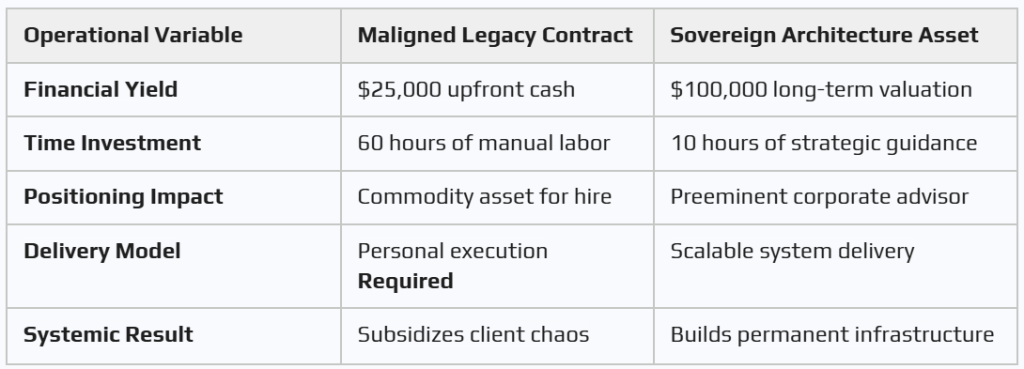
The cash flow from a maligned contract provides short-term comfort while creating long-term operational stagnation. Every hour spent executing a legacy process is an hour stolen from your proprietary system development. You are using your premium strategic energy to perform basic maintenance for an organization that refuses to mature.
THE FORTRESS BLUEPRINT | DESIGN SPECIFICATIONS
A fortress without a gate is a prison. A fortress without a guard is a ruin.
Sovereignty requires defense. Building a sustainable operation is an infrastructure choice, yet exceptional leaders often fail here because enforcing a boundary triggers an immediate emotional penalty.
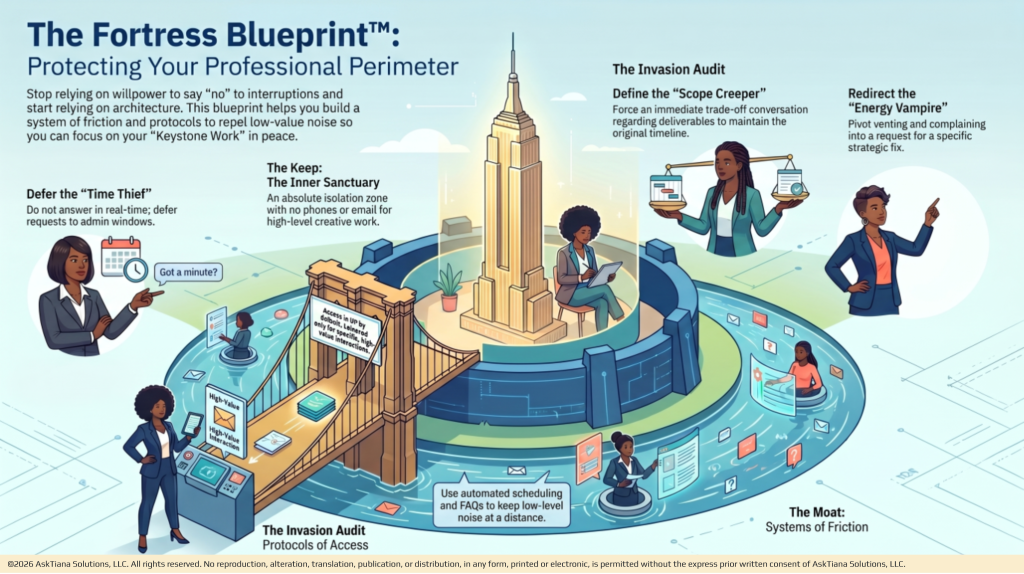
The Fortress Blueprint demands that you view your business as a physical structure. The walls are your non-negotiable operational rules. The gate is your intake system. The guard is your personal discipline in executing your refusal protocols. If you do not install a guard at the gate, your business will be overrun by the administrative demands, informal requests, and low-yield projects of other organizations.
A fortress is not designed to keep the entire world out. It is designed to regulate access. It ensures that any entity entering your operational perimeter complies with your structural standards. If an enterprise client wishes to access your genius, they MUST enter through your established architectural framework. They cannot bypass your structure by waving a check or inventing an emergency.
If you operate without these design specifications, your fortress collapses into a ruin. You become accessible 24/7. Your phone becomes a public asset. Your inbox becomes a storage facility for other people's priorities. You find yourself answering emails on Sunday evening, reviewing documents during your family dinner, and altering your core pricing models to accommodate a client who does not respect your value. This is not entrepreneurship. This is a corporate job without an internal human resources department to protect your well-being.
THE CRITICAL ACCOUNTING OF THE GUILT TAX
The primary reason leaders refuse to enforce the gate is the fear of being perceived as difficult, unhelpful, or unkind. When you transition from a people-pleasing orientation to an authoritative executive presence, you experience an internal friction.
We call this friction the guilt tax.
You MUST pay this tax to buy your freedom. Feeling uncomfortable when you reject a misaligned request is simply the cost of protecting your corporate asset. If you refuse to pay the emotional cost of a firm refusal, you will pay a structural cost later. You will end up paying with your time, your health, and your enterprise health.
Let us strip the emotion out of this critique and look at the math of truth. When a colleague asks to pick your brain over coffee, they are asking you to perform a fractional advisory session for the price of a beverage. They are outsourcing their intellectual labor to you because they do not want to invest the energy to solve their own foundational problems.
THE GUILT TAX EQUATION | STRATEGIC CHOICE MATRIX
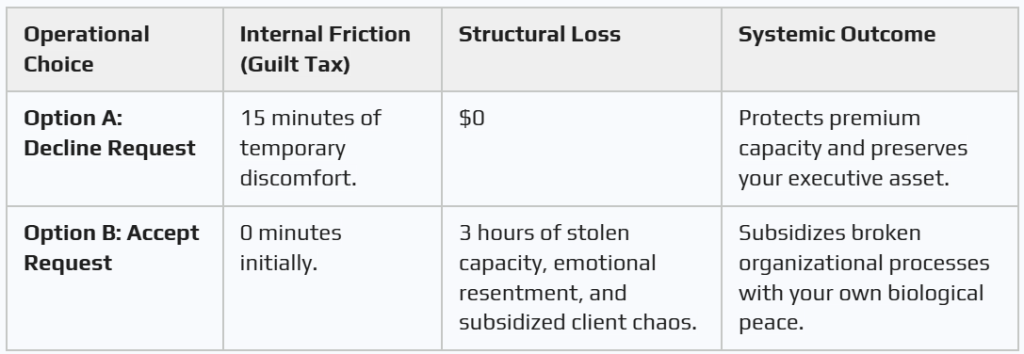
CONCLUSION: Pay the guilt tax immediately. It is the cheaper operational expense.
If you accept that meeting, you are validating the false premise that your expertise is a commodity. You are teaching your network that your strategic insights can be extracted without a formal contract, a clear framework, or financial compensation. The guilt tax is a minor, temporary operational expense. Paying it immediately ensures that your capacity remains reserved for the high-ticket clients who value your strategic blueprint.
THE RESILIENCE LAB
Inside the Resilience Lab, our cohorts are directly facing the invaders. Over the course of the season these women have successfully moved their complexity into clarity. They have designed their proprietary frameworks, defined their core value propositions, and claimed the title of Sovereign Architect.
Now, they are experiencing the definitive test of their new architecture.
The corporate environments they exited are calling them back. Former directors are reaching out with short-term consulting opportunities. Professional acquaintances are cluttering their inboxes with requests for free structural feedback on organizational plays. The market is trying to force them back into the role of the Jane of all trades.
In our live sessions, we completely drop the sugar. We do not offer soft landing pads or comforting preambles. We hold up a mirror to their self-sabotage using objective data and their own stated intentions.
We script their refusals in real time. They discover that saying no to legacy revenue is an absolute prerequisite for enterprise scale. If they choose to accept the old contracts, they are choosing to stay in the demolition zone. They learn that if you do not defend the asset, you lose the asset.
THE TOOL | THE CATEGORICAL NO
To survive the transition from a tactical fixer to a sovereign executive, you MUST deploy the categorical NO. This is not a case-by-case evaluation. It is an absolute, structural boundary applied to an entire classification of requests. There is no context-dependent negotiation. There is no exception based on historical relationships or professional guilt.
When you use a case-by-case approach to boundaries, your decision-making capacity is depleted. Every request requires an extended internal debate. You wonder if you can fit the meeting into your schedule. You consider if the client might eventually buy a premium package. You worry about damaging a professional relationship. This internal debate is an avoidance tactic.
A categorical NO eliminates the debate entirely. The rule is absolute, established in a state of operational clarity, and executed without emotion.
Identify the specific categories of demand you will permanently eliminate from your business operations this week.
Category 1: Operational Entitlement under the Guise of Informal Mentorship
This category includes any request to review an unvetted document, provide feedback on a strategy deck outside a formal contract, or participate in an informational interview designed to extract your business systems.
Category 2: Asynchronous Communication and Document Delivery During Rest Hours
This category includes any expectation from clients or vendors to receive responses to text messages, emails, or platform alerts during designated family, spiritual, or rest windows.
Category 3: Custom Delivery Formats Outside Your Proprietary System
This category includes any client who requests that you alter your core delivery structure to accommodate their preferred manual processes, such as writing custom summary packages after individual advisory sessions when your blueprint does not include that administrative asset.
EXECUTIVE SCRIPTS AND DEPLOYMENT ARCHITECTURE
A script is not an emotional document. It is a structural gatekeeper. To ensure your executive presence is maintained, your written refusals MUST be direct, declarative, and completely free of defensive explanations. Do not apologize for your parameters. Do not include phrases like "I am sorry that I cannot help you" or "I wish I had the time." These qualifiers diminish your sovereign authority and signal that your boundary is open for negotiation.
Save these templates in your operational notes. When an invader enters your perimeter, select the appropriate text, insert the client name, and transmit the response instantly. Pay the guilt tax and move forward.
Protocol A: The Informal Advisory Refusal
"Thank you for reaching out to connect. I have restructured my operations to focus entirely on high-ticket strategic architecture and enterprise systems design. Because of this structural shift, I no longer participate in informal advice sessions or brief informational consultations. If you would like to review our formal advisory engagement options and examine how we move operational complexity into clarity, let me know and I will provide our current strategy brief."
Protocol B: The Legacy Project Refusal
"Thank you for the consideration and the opportunity to support your team. My firm has transitioned away from project-based tactical execution and contract coordination. We operate exclusively to design scalable frameworks and provide high-level governance for organizations undergoing structural transformation. We are not accepting implementation contracts at this time. If your leadership requires a framework to scale your internal team, we can discuss our advisory packages."
Protocol C: The Custom Scope Boundary
"I receive your feedback regarding the delivery format. To maintain our operational standard and ensure data precision, we execute our advisory services strictly through our established proprietary system. We do not provide customized administrative summaries or altered reporting schedules outside the original blueprint. This structure ensures your organization focuses on the primary operational actions rather than manual maintenance. Let us return to the sequence outlined in our planned matrix."
THE COMMAND PRINCIPLE | DEFENDING THE ASSET
Sovereignty is not an award given to you by a corporate board. It is an infrastructure choice you make for yourself. High-achieving women are consistently socialized to act as the ultimate maintainers of other people's structures. You are taught that your value increases when you are indispensable, accessible, and endlessly patient with institutional incompetence.
This is a corporate trap. It is the invisible cage of fear that keeps you positioned as a tactical fixer rather than a visionary architect.
When you refuse to build a fortress around your capacity, you are making a choice to limit your business scale. You are indicating that you prefer the familiar fatigue of manual execution over the sovereign responsibility of leadership.
The leaders who require your premium advisory services are not looking for an accessible assistant. They are looking for a sovereign pioneer fueled by fire and clarity. They are looking for an executive who commands respect by demonstrating how to defend an asset floor by floor. If a client observes that you cannot protect your own calendar from informal invaders, they will never trust you to design the fortress boundaries for their enterprise.
Review your current calendar. Identify the Trojan Horses you have allowed into your infrastructure under the guise of opportunity. Deploy your categorical no. Write the template. Enforce the gate.
Protect the architecture.
FORTRESS DEFENSE AUDIT MATRIX
Execute this diagnostic process immediately before finalizing your operations for the week.
- Asset Evaluation: Identify the largest financial contract currently on your table. Is it purchasing your strategic blueprint or your manual labor?
- Leakage Accounting: Count the number of informal advice requests received this month. How many times did you fail to pay the short-term guilt tax?
- Infrastructure Check: Examine your saved response templates. Are your scripts declarative, or are you leaking authority?
REQUIRED ACTION: Clear the calendar of one misaligned invitation today.
What is the specific request category you will permanently eliminate from your perimeter today?
Make today marvelous. Let’s get to work.